
When things fall apart, follow the sardines
April had a plan, and then it didn't.
I had invested real energy in something I believed in — a clinic arrangement that I hoped would open a door, not just for my business, but for the people I most want to reach. I had pictured it, prepared for it, built it into my sense of what the next chapter looked like. And then, quietly and conclusively, it didn't work. No dramatic ending. Just the slow, sober recognition that the vision I had been running on was a mirage.
The first few days were hard — the way where rejection sits in your chest and doesn't move, where the gap between what you hoped and what is feels very wide, where you wake in the morning and the despair is the first thing to greet you.
My first instinct was to put the warrior suit on, get up and make the next plan. But by now I know that it doesn't work. No good decisions are made in a state of disarray. You cannot replace the feeling with a strategy.
My heart wanted to sink, and I let it
So I slowed down. I rolled out the yoga mat and let the practice move the energy that had nowhere else to go. I sat in meditation until my mind stopped churning and settled into something quieter. I ate mindfully even in the absence of appetite. I kept quiet a lot and went to bed early. And sometimes I talked to the friends who know how to be present without fixing. I received support, which is not always the easy thing for someone who spends her working life offering it.
I made space for the whole thing, and I waited.
There is a phrase that came to me during that week, and I have been carrying it since.
Adaptability is not a consolation prize for when the plan fails. It is the plan.
Because here is what I know from working with bodies: the system doesn't strengthen during the stressor. It strengthens during the recovery. The capacity is built in the pause, in the stillness, in the deliberate act of not pushing through before you're ready. The week of feeling it fully, of not moving until there was clarity, was not lost time. It was the work that allowed me to adapt.
By the end of it, something had shifted. Gently at first, then with a momentum I hadn't anticipated. I started making new plans, reaching out in new directions, finding a different substrate to run on. The energy that had been sitting in disappointment became fuel. Not bypassed. Metabolised.
We move, we sense, we measure, we make sense, we make space, we learn, we make the next move.
Sometimes we want the whole plan before we've gathered enough information to build it. The honest answer, the one I keep coming back to, is that clarity comes after the dust settles, not before. We have to tolerate the adaptation gap.
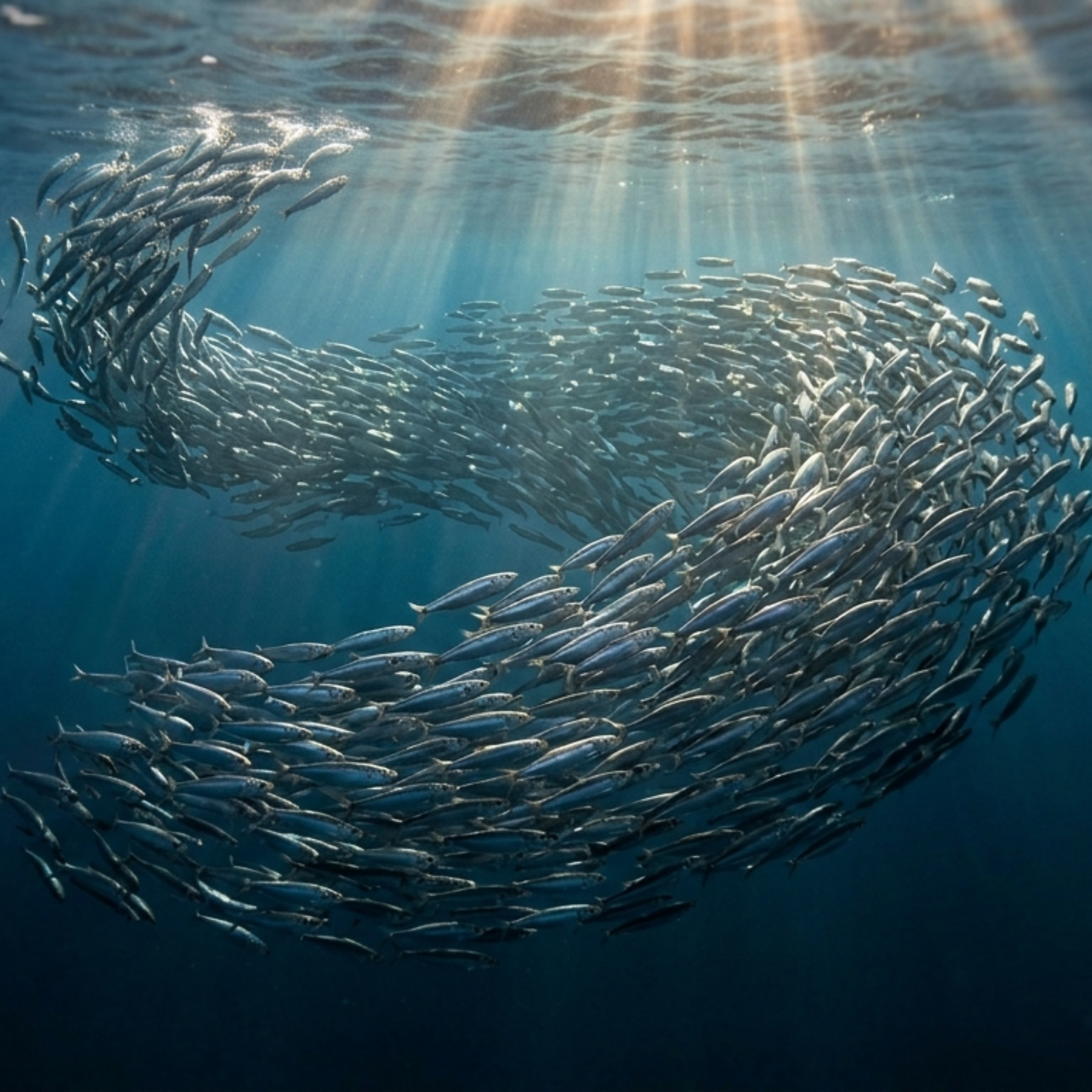
Following the sardines
And then, as a systems thinker, my brain lit up and found the biological parallel.
I had been experimenting with a sardine fast — three days, sardines, salt, water, herbal teas. I chose it deliberately over a standard water fast because I have a sensitive nervous system, and I know from experience that extended water fasting drives my cortisol up hard, which destroys my sleep and rather defeats the purpose.
The sardine fast is a fasting mimicking protocol. You give the body just enough protein and fat to prevent the cortisol spike, while still triggering the cellular processes that a fast is intended to produce. Autophagy — the body's internal cleansing mechanism — begins to activate. Inflammatory markers reduce. Insulin levels drop and insulin sensitivity improves. The gut gets a genuine rest from digestion. The bacterial environment shifts. Cells regenerate. All of this, without the stress cost of water alone.
What surprised me was how easy it was. My body said thank you. No bloating, no discomfort, normal digestion throughout. And when it was over, I found myself thinking: what if I extended this direction? What if I reduced fermentable substrate for longer, gave my gut a quieter season, shifted the environment more substantially?
The more I researched, the further I went. Ketogenic principles. Carnivore eating for gut repair. And here is where I have to laugh, because I was a vegetarian and then a vegan for ten years. I believed, genuinely and not casually, that plants were the foundation of everything. And now I am sitting here having eaten red meat and eggs all day, and my digestion is calmer than it has been in years.
We move, we sense, we measure, we make sense, we make space, we learn, we make the next move. And I should add: we let go of preconceptions, expectations, ideologies. Because what the sardines gave me was real, actionable data. Plants don't work for me. At least for now. So I take this on board and let it guide my next step.
That's holistic medicine in practice, right there.
The adaptation gap
In metabolic science, there is a concept called metabolic flexibility — the body's capacity to shift between fuel sources: glucose when it's available, ketones when it isn't. A metabolically flexible body doesn't collapse when the primary substrate changes. It adapts. It finds another way to generate energy from what it has.
A body that can only run on glucose — one that has lost the enzymatic and hormonal machinery to shift — will crash when glucose isn't there. It has no contingency. It has forgotten how to use anything else.
Experimenting with carnivore and ketogenic eating made this vivid. When you remove glucose as a primary fuel, the body goes through a period of inefficiency. Energy drops. Cognition feels slower. There is a phase, sometimes days, sometimes weeks, where the body hasn't yet built the mitochondrial and enzymatic infrastructure to run cleanly on fat and ketones. It knows the old way no longer applies, but the new way isn't fluent yet.
This is the adaptation gap. It is uncomfortable, and it is necessary. It is not failure. It is transition.
And it is the same gap I sat in during that difficult week in April. The same gap many of you are sitting in, in your own way, right now. The gap between the fuel source that has run out and the one that hasn't yet come online. Your innate intelligence is still there. So is your capacity. Your system is simply rebuilding its machinery for what comes next.
Trust that.
Enough
I am still in the middle of this experiment, in both the biological and the personal sense. What I have is a deepening trust in the process, and a growing willingness to let the clarity come when it does, rather than trying to manufacture it before.
When life doesn't go your way, remember: you have everything in you to adapt.
Follow the sardines. Keep what's working. Let go of what doesn't serve you. And slowly the dust settles. Clarity comes. A new path opens.
We move, we sense, we measure, we make sense, we make space, we learn, we make the next move.
That is enough.